
Day of the Dead vocabulary starts with a handful of Spanish words: ofrenda (the altar of offerings), calavera (skull), cempasúchil (marigold), pan de muerto (bread of the dead) and papel picado (cut-paper banners). Each one names a piece of Día de Muertos, the Mexican holiday on November 1 and 2 that welcomes departed loved ones home.
Below you will find 25 terms with pronunciation and meaning, sorted by where you will meet them: the calendar, the altar and the famous skeletons. Along the way, we clear up how the holiday differs from Halloween, which word hides the number twenty, and why a skull can also be a car part. Explore our translation services services for details.
Key Takeaways
- Día de Muertos is observed on November 1 (for children) and November 2 (for adults), and it is a celebration of memory, not a night of frights.
- The ofrenda is the heart of the holiday: an altar of photos, candles, flowers, food and drink prepared for a returning loved one.
- Several key words, including cempasúchil, copal and atole, came into Spanish from Nahuatl, the language of the Aztecs.
- La Catrina and the alebrije are much younger than the holiday itself: both date from the 20th century.
- UNESCO recognizes the festivity as Intangible Cultural Heritage of Humanity.
What Is the Day of the Dead?
Día de Muertos is a holiday that began in Mexico and is now also observed in other parts of Latin America and in the United States. Families remember relatives who have died by building altars at home, visiting graves, cooking favorite dishes and telling stories. The mood is warm, colorful and often funny.
According to UNESCO, which inscribed the festivity on its heritage list in 2008, the holiday marks “the transitory return to Earth of deceased relatives and loved ones.” UNESCO describes it as a fusion of pre-Hispanic religious rites and the Catholic feasts brought by the Spanish in the 16th century: All Saints’ Day on November 1 and All Souls’ Day on November 2.
A fair warning about the history: you will often read that the holiday is an unbroken Aztec tradition thousands of years old. Historians disagree on that. Some emphasize Indigenous roots, while others argue that much of the modern celebration grew from Spanish Catholic customs and took its current shape in the 20th century. The honest answer is that it is a blend, and scholars still debate the proportions. Explore our Spanish dialects and cultural nuances for details.
How Is Day of the Dead Different From Halloween?
The two holidays sit side by side on the calendar and share some skeletons, so the mix-up is understandable. Still, Britannica calls Day of the Dead “distinct in both origin and meaning” from Halloween. Calling it “Mexican Halloween” misses the point.
|
|
Day of the Dead | Halloween |
|---|---|---|
| When | November 1 and 2 | October 31 |
| Mood | Joyful remembrance; the dead are welcome guests | Playful scares and mischief |
| Focus | Specific family members and friends who have died | Costumes, candy and spooky fun |
| Centerpiece | The ofrenda at home and the decorated grave | Trick-or-treating and parties |
In short, the skulls here are smiling for a reason. Death is treated as a familiar part of life, and the people being remembered are greeted with their favorite food, not feared.
Day of the Dead Vocabulary: The Holiday and Its People
Start with the words for the days themselves and for the people being honored. Pronunciations are approximate guides for English speakers, with the stressed syllable in capitals.
| # | Spanish term | Pronunciation | Meaning |
|---|---|---|---|
| 1 | Día de Muertos | DEE-ah deh MWEHR-tohs | Day of the Dead. You will also see the longer form, Día de los Muertos. |
| 2 | angelitos | ahn-heh-LEE-tohs | “Little angels”: children who have died. They are remembered on November 1. |
| 3 | difuntos | dee-FOON-tohs | The deceased. November 2, when adults are honored, is also called Día de los Difuntos. |
| 4 | ánima | AH-nee-mah | A soul. In Catholic tradition, specifically a soul waiting in purgatory. |
| 5 | panteón | pahn-teh-OHN | A cemetery, in Mexico and much of the Americas. Families gather here to clean and decorate graves. |
A small translation trap hides in number 5. In Spain, a panteón is usually a monumental family tomb, or a pantheon of gods. In Mexico it is simply the everyday word for cemetery. Explore our evolution of the Spanish language for details.
What Goes on an Ofrenda? 11 Altar Words
An ofrenda is not for worship. It is a welcome table. As the Smithsonian explains, a traditional altar represents four elements: water in a pitcher, papel picado for wind, food (especially bread) for earth and candles for fire.
| # | Spanish term | Pronunciation | Meaning |
|---|---|---|---|
| 6 | ofrenda | oh-FREHN-dah | Literally “offering.” The home altar and everything placed on it for a returning loved one. |
| 7 | altar | ahl-TAR | The table or tiered structure that holds the ofrenda. Same spelling as English, different stress. |
| 8 | retrato | reh-TRAH-toh | A portrait or photograph of the person being remembered. |
| 9 | veladora | veh-lah-DOH-rah | A candle (a Mexican usage). Its flame lights the way home. |
| 10 | cempasúchil | sem-pah-SOO-cheel | The Mexican marigold, whose color and strong scent guide souls. Also spelled zempasúchil. |
| 11 | papel picado | pah-PEL pee-KAH-doh | “Punched paper”: tissue-paper banners with cut-out designs. They stand for wind. |
| 12 | copal | koh-PAHL | A tree resin burned to cleanse the space. The word comes from Nahuatl copalli. |
| 13 | incienso | een-SYEN-soh | Incense, often used alongside or instead of copal. |
| 14 | agua | AH-gwah | Water, a symbol of the source of life and the purity of the soul. |
| 15 | sal | sahl | Salt, which represents purity and purification. |
| 16 | juguetes | hoo-GEH-tehs | Toys, placed on altars made for children. |
Cempasúchil deserves a second look. The dictionary of the Real Academia Española traces it to the Nahuatl words cempoalli (“twenty”) and xóchitl (“flower”). Families scatter the orange petals in a path so that returning souls can follow the scent to the altar.
Skulls, Skeletons and Sweet Bread: 9 More Words
This is the vocabulary you see on posters, face paint and bakery shelves.
| # | Spanish term | Pronunciation | Meaning |
|---|---|---|---|
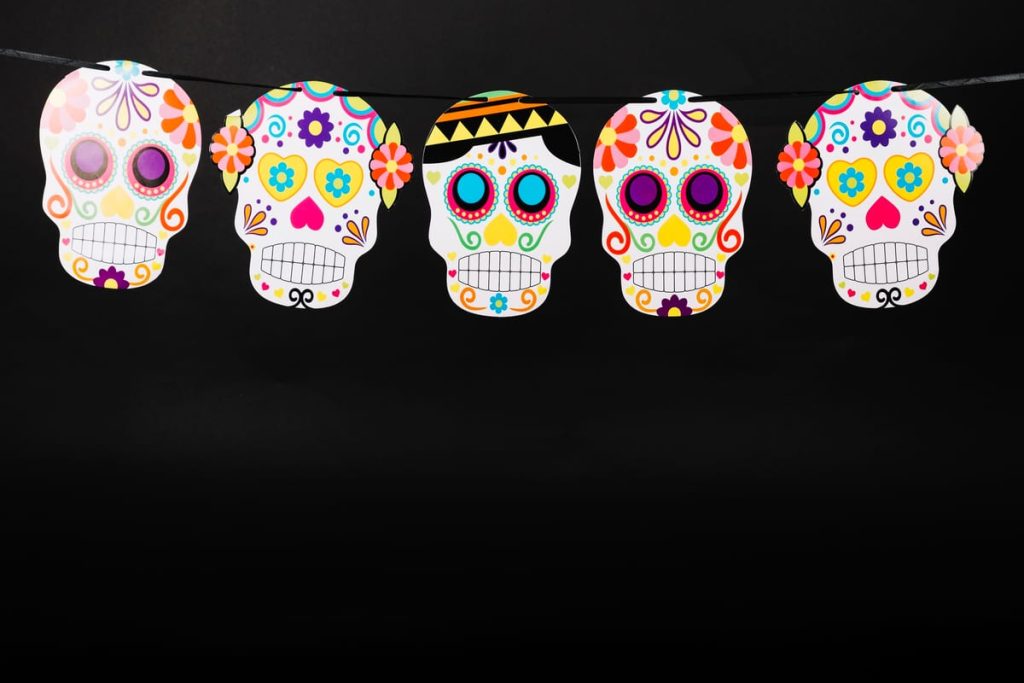
| 17 | calavera | kah-lah-VEH-rah | A skull, the holiday’s signature image. |
| 18 | calaverita de azúcar | kah-lah-veh-REE-tah deh ah-SOO-kar | “Little sugar skull”: a brightly decorated candy skull for the altar. |
| 19 | calavera literaria | kah-lah-VEH-rah lee-teh-RAH-ryah | A short, teasing poem that imagines a living person’s death, written like a joke epitaph. |
| 20 | calaca | kah-LAH-kah | An informal Mexican word for a skeleton figure, and for death itself. |
| 21 | La Catrina | lah kah-TREE-nah | The elegant skeleton lady in a wide feathered hat, based on a print by José Guadalupe Posada. |
| 22 | pan de muerto | pahn deh MWEHR-toh | “Bread of the dead”: a soft, sweet loaf topped with bone-shaped strips of dough. |
| 23 | atole | ah-TOH-leh | A warm, thick corn-based drink. The word comes from Nahuatl atolli. |
| 24 | alebrije | ah-leh-BREE-heh | A brightly painted sculpture of an imaginary animal. A modern addition to the imagery. |
| 25 | mariposa monarca | mah-ree-POH-sah moh-NAR-kah | The monarch butterfly, believed to hold the spirits of the departed. |
The lady in the hat
La Catrina feels ancient, but she is barely a century old. Printmaker José Guadalupe Posada etched her around 1910 to 1912 as satire, poking fun at Mexicans who put on European airs. The name “Catrina” was attached to the image later, and Diego Rivera made her a national icon by painting her into a mural in 1946–47. Explore our translating Spanish terms with precision for details.
Poems with a grin
Calaveras literarias are one of the holiday’s most playful customs. Children and adults write short rhyming verses about friends, teachers, coworkers and politicians, describing how Death comes to collect them. The tone is mocking but light-hearted, and being teased in a calavera is usually taken as a sign of affection.
A word about alebrijes
Alebrijes were invented in 1936 by Mexico City artisan Pedro Linares and were not traditionally part of the holiday. Many people now link them to it because of the animated film Coco, where they appear as spirit guides. Enjoy them, but know they are a recent guest at the party.
Why These Words Are Hard to Translate
Look back at the list and you will notice how many terms resist a one-word English match. “Offering” is a correct translation of ofrenda, yet it loses the photos, the candles and the whole idea of setting a place for someone you miss. Calavera means skull, but in Mexico it can also mean a joke poem or even a car’s taillight. Context decides. Explore our professional Spanish translation services for details.
That is exactly the kind of judgment a human translator brings to family letters, memorial programs, school materials and community event flyers. If you need Spanish text handled with that care, our Spanish translation services pair you with translators who know the regional differences. For more examples, see our posts on Spanish words that are difficult to translate and the different dialects of Spanish.
Frequently Asked Questions
When is the Day of the Dead celebrated?
Day of the Dead is celebrated on November 1 and 2 each year. November 1 is devoted to children who have died, often called angelitos, and November 2 honors adults. The dates match the Catholic feasts of All Saints’ Day and All Souls’ Day. In many communities the preparations start earlier, with families shopping for flowers, baking bread and building altars in the last days of October.
What does ofrenda mean in English?
Ofrenda literally means “offering.” During Day of the Dead it refers to the home altar and everything arranged on it: a photo of the person being remembered, candles, marigolds, water, salt, bread, favorite dishes and personal belongings. The ofrenda is not an object of worship. It works more like a welcome table, set out so that a returning loved one feels expected and at home.
Is Day of the Dead the same as Halloween?
No. Halloween falls on October 31 and centers on costumes, candy and playful scares. Day of the Dead follows on November 1 and 2 and centers on remembering specific family members and friends with altars, food, flowers and visits to the cemetery. The two share skeleton imagery and a spot on the calendar, but they differ in origin, meaning and mood. Explore our certified document translation services for details.
What is the Day of the Dead flower called?
The flower is the cempasúchil (sem-pah-SOO-cheel), known in English as the Mexican marigold. Its name comes from Nahuatl words meaning “twenty” and “flower.” The plant is native to Mexico, blooms in bright yellow and orange, and has a strong fragrance. Families use the blossoms on altars and graves and scatter the petals in paths so that souls can find their way.
Who is La Catrina?
La Catrina is the elegant female skeleton in a large, flowered and feathered hat who has become the best-known face of Day of the Dead. She began as a satirical print by Mexican artist José Guadalupe Posada, first published in 1913. Diego Rivera later painted her full figure in a famous 1946–47 mural, which turned a newspaper joke into a national symbol.
Need Help With Spanish? Let’s Talk
Whether you are translating a family document, a school handout or an invitation to a community celebration, our human translators are happy to help. Chat with us for a quote, or call 1-800-230-7918 and tell us what you need.